“The Dusseldorf School of Photography” by Stefan Gronert

I bought this book to learn more about the famous Dusseldorf School of Photography.  The book does a good job of reinforcing and dispelling some myths about the school.  It consist mainly of large format printed photos and an essay titled “Photographic Emancipation” written by Stefan Gronert.  The photos are divided into three parts: part one focuses on the school’s founding gurus Bernd & Hilla Becher; part two its more famous pupils; and part three its lesser known practitioners.  There is a very well researched and comprehensive “Biographies, Exhibitions and Further Reading” section by Isabelle Matz and Maria Muller at the end of the book.

Stefan Gronert’s essay serves as a legend for the photos by covering the 11 approaches of “Photographic Emancipation”.  Although Gronert doesn’t spell out these 11 approaches exactly one can assume they roughly follow his headings.  These sections effectively sets up a dialogue between the artists.  Gronert points out that it was Axel Hutte who first started to do portraits but Thomas Ruff and Thomas Struth who later became more well known for them.  The author also compares and contrasts: the library photos of Candida Hofer with Andreas Gursky; and the street photos of Petra Wunderlich with Thomas Struth.  Gronert seems to dedicate a special section to Thomas Ruff’s work due perhaps to his more diverse oeuvre.

The insights in Gronert’s essay adds more flavor to the photos.  Some examples being Thomas Struth’s pictures of pictures or as Gronert refers to them as meta photos.  These photos of paintings in museums (the bottom photo on the book’s cover) are given another dimension when you learn that each scene was methodically captured over and over until one image “fit the bill”.  This according to Gronert gives the photos a much more authorial constructed reality.  For me personally they look somewhere between staged and found.  Jorg Sasse’s “Speicher I” is a photo-sculpture and image database system that allows the viewer to organize photos by themes.  In this day and age of The Cloud it’s interesting to see how artist physically interpret these concepts.

The Photos

Here are some personal observations about the photos by the various photographers in the order they are presented in the book:

Bernd & Hilla Becher

In so much as the photos are seen to be reproductions of reality, the repetitive nature of the photos’ subject matter are also reproducing themselves as well.  The repetition also encourages you to stop seeing the subject matter all together and start seeing the abstractions.

Andreas Gursky

By having AG follow B&HB’s work in the book helps to emphasize B&HB’s influence of scale on AG’s photos.  This arrangement also helps to contrast the non-monumentality of AG’s photos when compared to B&BH’s .  In AG’s photos it is the tableaux that becomes the monument.  One of my favorite photos from this series is “Baharain I” for its “all over-ness” and abstraction.

Candida Hofer

In contrast to AG, CH’s focus is more on space and depth.  There’s also a fractal thing going on in the photo of the room with boxes on the shelves alludes to the further subdivision of space in to smaller and smaller modules.  He seems to use this compositional strategy quite frequently.

Axel Hutte

Perhaps it’s the influence of Gronert’s essay but AH’s work seem to contain the seeds of the work of his peers.  There are fractal like spaces, deep voids, all over hill side/jungle foliages and icebergs, atmospheric environments, objects in far off distances.

Thomas Ruff

First time in the book that portraits appear in the artists’ represented photos.  And also one of the first to incorporate found “objects” (space photos, jpegs from the internet) in his photos shown in the book.  As mentioned before TR’s photos cover a diverse range of subjects.

Thomas Struth

His work deals with the topic of public spaces in his museum photos and also private spaces in family portraits taken in homes.  In the former the people are seemingly unaware of their presence in the photos whereas in the later there is a direct confrontation between viewer and subject.  It’s interesting to see these polar opposites side by side in the book.

Petra Wunderlich, Laurenz Berges, Elger Esser, Simone Nieweg, Jorg Sasse

PW has a series of stone quarry and stone buildings which I like for their negative and positive spaces respectively.  There’s an awesome photo by LB called “Delmenhorst” that has a snow laden tree against a blue wall that looks like a silkscreened sky.  EE’s photos are very painterly and I particularly like the one of the ocean wave called “265 Dieppe”.  Of all the foliage themed photos I think SN’s are the most successful.  I particularly like “Garden Fence with Rug, Gelsenkirchen” which has an all-over and consistent feeling that is present in all her photos.  Three photos from Jorg Sasse which I absolutely admire.  There’s the photo of the yellow vase against a purple background that is very abstract and Escher-esque.  The volcano and the butcher photos (actually two photos) for their texturing and patterns.  And I also like the speeding train photo for the strong horizontal composition and color contrast.

Conclusion

The book serves as a good overall guide to the key figures of The Dusseldorf School.  It’s a good starting point to help the reader explore more about the individual photographers.  The book is also very effective at putting everything in context so that influences and offshoots can be seen more clearly.  Most importantly it enables the reader to discover and appreciate the work of the lesser known students of the school.

“Paris” by William Eggleston

“Paris” is a handsome book published by Steidl on the occasion of Eggleston’s exhibition at the Fondation Cartier pour l’art contemporain in 2009.  Eggleston – father of color photography – was commissioned by the Fondation Cartier to photograph Paris over the course of a 3 year period.

But don’t expect your typical tourist shots of the Eiffel Tower and the Musee Rodin.  “Paris” is the places and spaces in between: graffiti on glass, posters on walls, trash in see-through garbage bags.  It’s all the things that you looked at without seeing while you are in Paris.  There is a particular focus on planar surfaces and patterns and this is reinforced by Eggleston’s abstract drawings which are interspersed in between his photos.

The drawings are almost like maps or lines one would draw with their eyes while looking at photographs.  Or maybe even a type of visual sheet music juxtaposing all the visual elements and motifs which Eggleston has honed throughout the years in his photographic practice.  It’s wonderful how photographers like WE and HCB also choose drawing as a creative outlet.  The camera is after all nature’s pencil.

As is expected from Steidl the book is beautifully crafted with sensuous black satin covers. It is organized into Books One and Two with Book Two containing several more drawings than Book One.  Most spreads contain one photo/drawing with some containing two.  This has the effect of forcing you to search for similarities or reasons for the pairings.  Most of the pairings are drawings with photos although there’s always some pairings that break the rule.  It’s quite an effective way to create more opportunities for the viewer to linger over the materials.

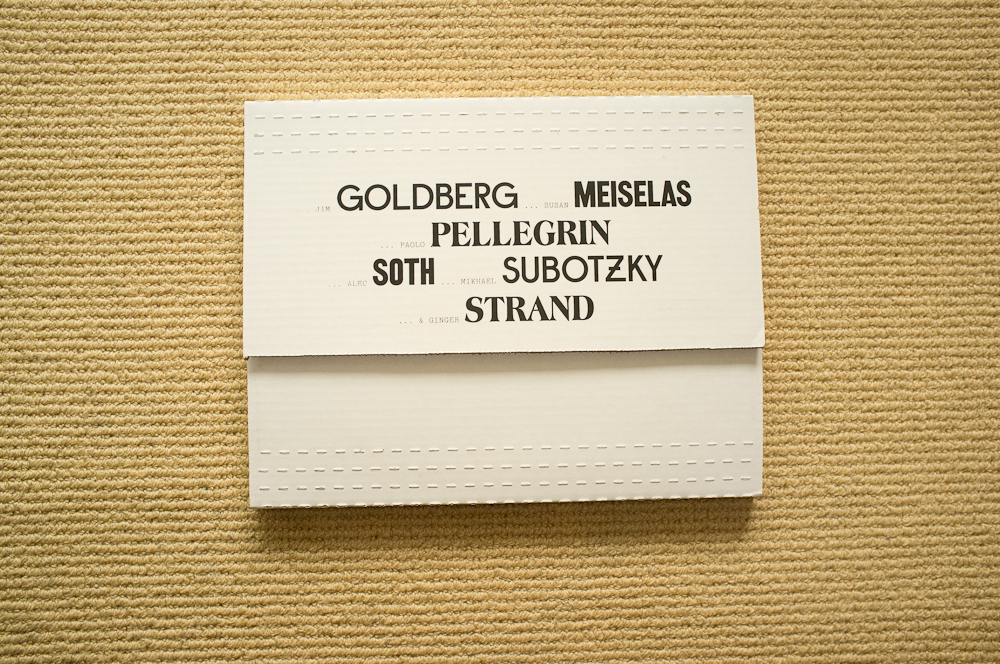
“Postcards from America” by Jim Goldberg, Susan Meiselas, Paolo Pellegrin, Alec Soth, Mikhael Subotzky, Ginger Strand

From the Postcards from America website:

“Postcards From America Box Set

In May 2011, five Magnum photographers –Paolo Pellegrin, Jim Goldberg, Susan Meiselas, Alec Soth, Mikhael Subotzky – and a writer, Ginger Strand, set out from Austin, Texas, in an RV. Two weeks and 1750 miles later, they arrived in Oakland, California.

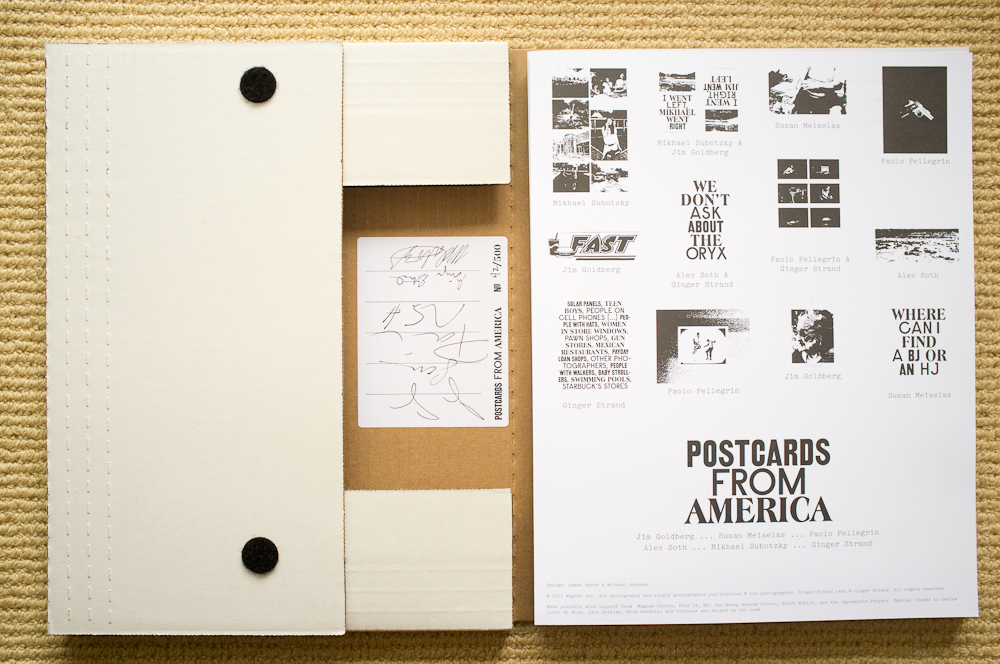
The resulting limited edition book is a collection of objects – a book, five bumper stickers, a newspaper, two fold-outs, three cards, a poster and five zines, all in a signed and numbered box – that collectively document the experience. Edition of 500, signed by all five photographers and the writer.”

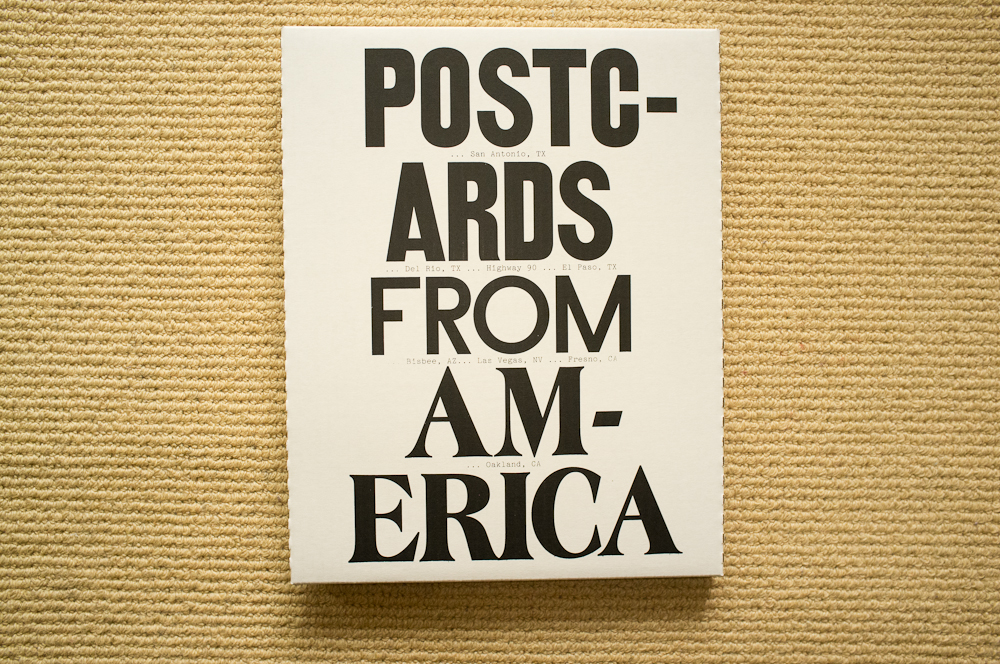
I received my copy this past week and it has exceeded all my expectations of what a photobook can be. It’s like receiving a care package from your college friends who just went on a road trip – but this one is filled with photographic goodies. Aside from the typography the box is unassuming and it could have said Fedex or DHL instead. This sets the overall tone of what’s to follow as you open the box and discover its contents.

Even the sticker where the photographers and writer have signed their names is stuck on in a very non-ornamental way. The “cover page” as shown in the photo above is comprised of high contrast images of the objects and “postcards”. It gives a sense of cohesiveness to the disparate jumble of materials. This is definitely not Robert Frank’s “The Americans” as there is no singular view imposed but instead multiple disparate narratives. Whereas “The Americans” focuses on what can be seen “Postcards” is more about what is absent and searching without finding.

I think what the authors are getting at is that only in America can such contrast exists side by side. That America is a whole bunch of parallel universes both perceived and actual all wound up into one big hodge podge. This reading of the work is strongly alluded to in Ginger Strand’s writing in the various zines. And also in the “I went right, Jim went left; I went left, Mikhael went right” wherein we meet a conflicted character that is both a caregiver and abuser?

One of my favorite photos is the abandoned pool that is filled with turf and grass. It’s about making do and turning contradictions into something that seems almost natural. You don’t see that it’s a pool until you realize where the diving board goes. It’s photos like these that provide the anchors to the entire collection. I’m sure I’ll find some more gems as I digest the work over the next few weeks.  Here’s a link to the official site.

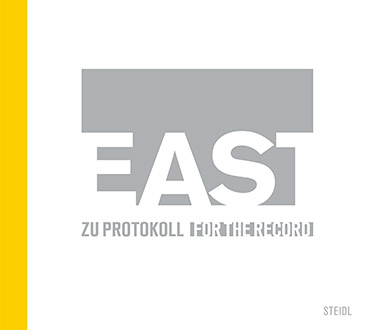
“East: For the Record” published by Steidl

“East” is a photographic record of the historic events that occurred between August 1989 and January 1990 that brought down the Berlin Wall and reunited East and West Germany.  However instead of using cliched newsroom photos of people standing on top of the Wall, it is the everyday lives of regular people during that time that is featured in the foreground and the “historical events” that serve as the backdrop.

The book is mainly written in German for a German audience however it does contain an English translation of the Forward, essays and photo captions to be found at the very end of the book.  The main body of the book is the Photography section which is divided into the months August, September, Oktober, November and Dezember.  Each spread is spaciously laid out with photographs, the Day. Month., name of the contributing photographer and a short caption.  The overall effect is one of non sentimentality letting the photos individually stand on their own but all the while contributing to the overall tone and momentum.  90 % of the photos are in black and white with color serving as accents here and there.

It is a powerful testament to how history is written by regular people just by living the way they choose to and changing the course of history in the mean while.  Would be great to see more photobooks like “East” that gives a clearer view of the everyday context that accumulate and add up to momentous events that affect all our lives.

If you like this review enough to buy the book, please purchase from the Amazon link here:
“EAST: FOR THE RECORD”

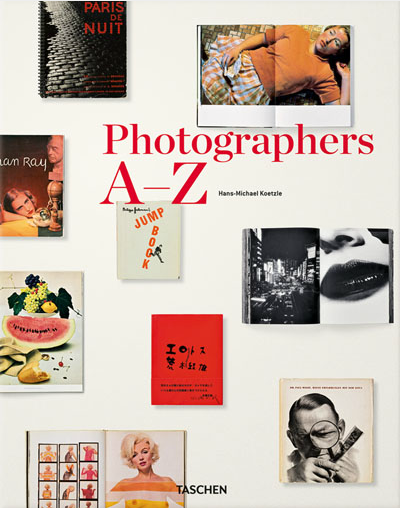
“Photographers A-Z” by Hans-Michael Koetzle

Received a copy of “Photographers A-Z” published by Taschen over the Christmas holidays.  It’s a great book for getting to know more about the masters as well as some up and coming photographers.  Although a hefty tome it is by no means exhaustive in scope and professes to be selective rather than encyclopedic.

It’s similar to “The Photobook” by Parr and Badger in that it showcases the photobooks of the photographers.  For aspiring collectors it also contains some selected exhibitions and bibliographical info as well.  The writing is a little rushed and summarized for my tastes but it does contain some useful information (the writing in the Parr and Badger book is much better).

It’s a good collectors item in and of itself and is definitely well made.  The font and layouts are elegant and very accessible for the reader.  Plenty of white space surrounding text and images which is good.  Overall I am quite happy with “Photographers A-Z” and highly recommend it for your bookshelves.

Photographers A-Z on Amazon.com

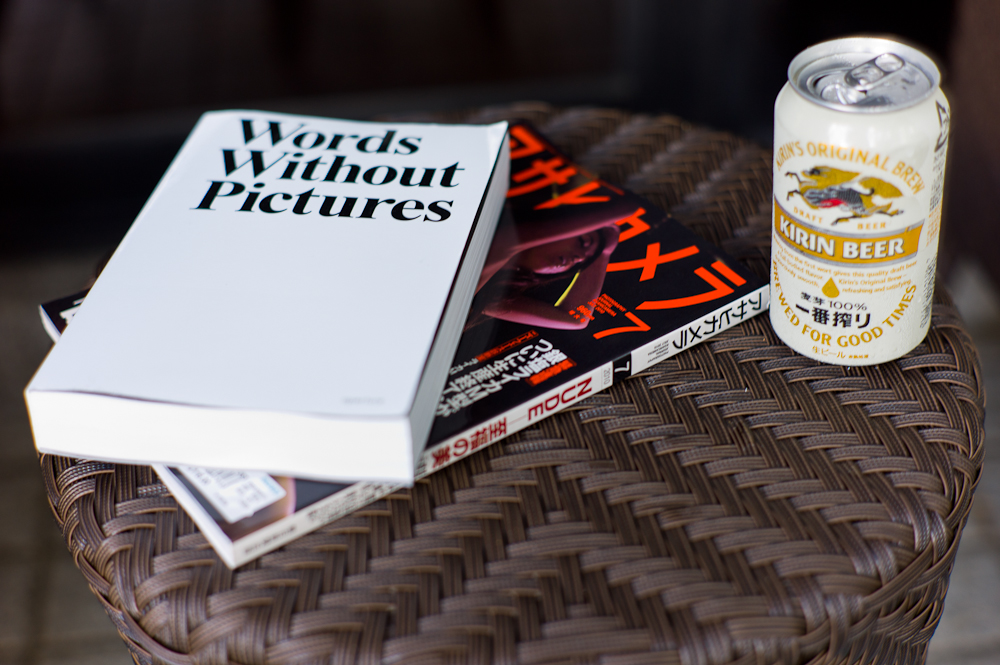
Words Without Pictures

What a wonderful way to enjoy a lazy summer Sunday with a fine book/magazine and an ice cold beer out in the yard!

I’ve yet to finish “Words Without Pictures” but it is highly recommended. The book covers a wide range of contemporary photography topics in a very informal and online-forum-like style. Each chapter starts with an essay or discussion on a particular topic followed by “audience’ response and Q&A sections (which is not necessarily related to the chapter topic).

I found the overall tone to be refreshing and largely avoids the heavy verbiage associated with photography discourse.

Kirin Beer is golden – brewed for good times indeed!

“The Photobook: A History volume II” by Martin Parr and Gerry Badger

Being completely clueless about photographers and the development of photography as a means of artistic expression and document, finding this book is like striking gold.

The book is very elegantly designed and laid out.  It is divided into nine chapters organized around various photobook themes.  The first three chapters starts with photobooks from America, Europe and the “Rest of the World” citing important differences and pre-occupations in these different cultures.  The remaining six chapters are less geographically based and more theme oriented.

The chapters start with a few introductory pages to set the scene before delving into the photobooks themselves which are presented in either one, two or three photobooks per spread.

Each photobook feature is comprised of page previews, a caption with some basic book info, and a short blurb about the significance of the book.  This catalogue of photobooks approach makes for a good compliment to your more standard textbooks such as “A World History of Photography”.

Here’s some more info on Amazon:

The Photobook: A History, Vol. 1
The Photobook: A History, Vol. 2
A World History of Photography

“Light & Shadow” by Daido Moriyama

Here’s another Daido book I picked up on my recent trip to Tokyo called “Light & Shadow.”

1247058725_daidolight

It is the same exact size as the “Buenos Aires” one which is also a re-release.  You can refer to my previous post on that book here.

To be honest with you I have no idea how to interpret this book. It is a dense and constant bombardment of low-fi black and white images. But that’s exactly why I love it because it’s a celebration of just that: Light & Shadow.

From what I can tell, there’s no story or theme running through it but pure unadulterated visual stimuli of the black and white variety. It’s a great way to teach yourself to see things in their own context as pure graphic elements.

I can recommend this book without any reservation!

As much as I love this copy I do envy those who own the original version:

102330

For previews of the book you can check this link out here.

Other books by Daido Moriyama:
“Buenos Aires”

“Buenos Aires” Daido Moriyama

51-tUInY6jL._SS400_

[UPDATE] Be sure to check out the book preview with sample images here

On my recent trip to Tokyo I picked up a bunch of photo books three of them by Daido Moriyama: “Buenos Aires”; “Light & Shadow” and “Erotica”.  I’ll first review the “Buenos Aires” in this post.

This 2009  edition is a re-release of a larger and more expensive book initially published in 2005 by Kodansha.  The original edition’s dimensions are 11.5 x 8.5 inches while this one being more portable and easy to flip through stands at 7 x 4.5 inches. Though cheaper than the original it is no less well packaged as it has an obi band and a softcover dust jacket.  The green cover you see in the photo comes off to reveal a darker greenish gray cover which on closer inspection is a subtlety printed photo.  All pages have matte finishing.

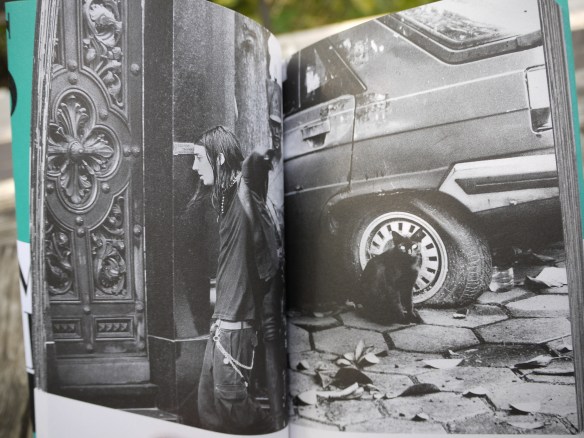
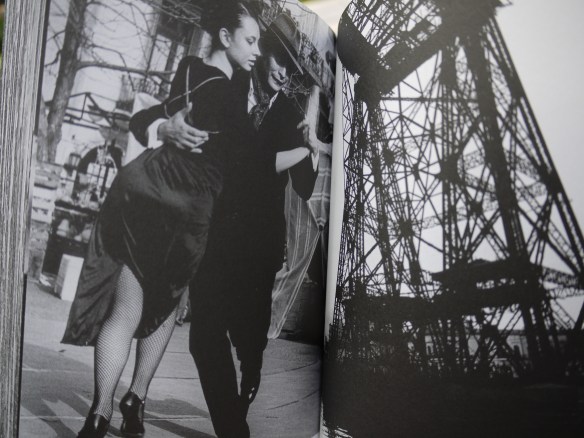
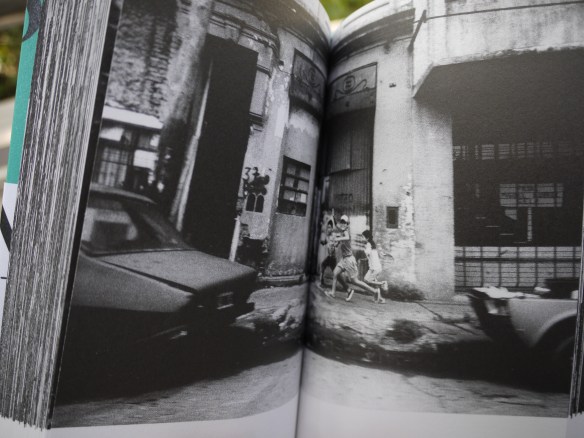
The book’s first dozen pages depicts sparsely populated streets and open spaces.  As it progresses the visual rhythm picks up and the streets get more crowded and frenetic activity starts taking over.   The restaurants and the bars become full with couples dancing – legs and bodies entwined.  Packed subway, cluttered storefront displays and a merry go round spinning wildly at night bring the book to a crescendo which then begins to finish the way it started.  Desolate streets, a pile of garbage and stray dog mark the final pages.

What I most appreciate about “Buenos Aires” is that it begs to be picked up and flipped through revealing new details and insights each time over the course of several readings.  It’s a great book for those who enjoy street photography whether Daido fan or not.

51564NA5R3L._SS500_

Here’s the link to the first edition of Buenos Aires on Amazon

“Buenos Aires” Picture Previews