Concentration
Reply
For the 100th post of this blog I’d like to share my review of the DVD version of “Let England Shake”.

PJ Harvey “Let England Shake” – 12 Short Films By Seamus Murphy is a collaboration that started when PJ saw Seamus’ exhibition and book of photographs ‘A Darkness Visible: Afghanistan’ and decided to make a couple of films for her new CD. It is a powerful tour-de-force that combines poetry, rock music, video and still images to weave a multi-textured narrative of Seamus’ road trip across England, and PJ Harvey’s haunting performances of her songs. It’s also the debute of Seamus as a film maker who has covered war torn countries around the world for decades in his photographs.
Each of the twelve films starts with seemingly random strangers reading the first verse of the songs. These performances are at times serious and at times tongue in cheek outtake-like clips. This adds to the sense of joy in the production found throughout the film which was made entirely in-camera. After the brief reading the film than cuts to PJ’s singing or the footage of Seamus’ road trip which run the gamut from idyllic sea and countrysides to hectic city streets.
The video and stills are edited together so that they reinforce each other: moving when you expect stillness and stillness when you expect movement. All the while working in near perfect unison with the music. Sometimes, the materials match up too nicely for my taste – like crashing ships and crashing waves in Track One – but that’s just being picky. In general it works beautifully like when cutting from the human skeleton to PJ or from the old woman to PJ – the ephemeralness of human life.

One of the more memorable scenes is the old folks in a dance hall swaying their hips (unbeknownst to them) to PJ’s song titled “The Words That Maketh Murder” – the video and audio incongruence is perfectly surreal. Then there’s the slightly out of focus projected images of people being pointed to by a disjointed hand from inside a camera obscura. All the while with the lyrics “I’m going to take my problem to the United Nations” playing over top.
There are a few recurring images that symbolize death such as the sea, fog and snow. One particularly potent image is a line of roses along an iron chain by the docks on a grey snowy day. Roses are repeated again when soldiers lay them on top of a hearse at a memorial service for a fallen comrade. Lots of beautiful flowers in the snow images makes one wonder what flowers in the winter? Then there are the images of death portrayed in Seamus’ war photography interspersed throughout the DVD. For the majority of the piece the adventures overseas are subtly alluded to by shots like the Afghan rug hanging on a roadside railing in the snow.
The film is not so much a contrast of war abroad and peace at home but rather the signs of death brought back and remembered through the everyday living. If all the images of actual war were removed from the film this message would still come through effectively. After watching the DVD I went to Seamus’ site to look at his still photos and found much sensitivity and poetry in his war photography. Which is a striking contrast when compared to his shots of regular life in the film which are at times tinged with violence and sadness.
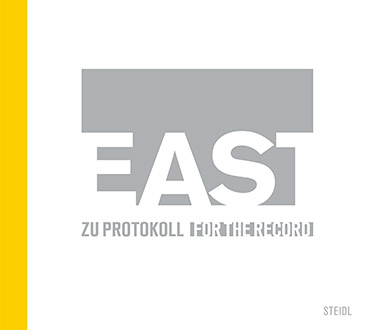
“East” is a photographic record of the historic events that occurred between August 1989 and January 1990 that brought down the Berlin Wall and reunited East and West Germany. However instead of using cliched newsroom photos of people standing on top of the Wall, it is the everyday lives of regular people during that time that is featured in the foreground and the “historical events” that serve as the backdrop.
The book is mainly written in German for a German audience however it does contain an English translation of the Forward, essays and photo captions to be found at the very end of the book. The main body of the book is the Photography section which is divided into the months August, September, Oktober, November and Dezember. Each spread is spaciously laid out with photographs, the Day. Month., name of the contributing photographer and a short caption. The overall effect is one of non sentimentality letting the photos individually stand on their own but all the while contributing to the overall tone and momentum. 90 % of the photos are in black and white with color serving as accents here and there.

It is a powerful testament to how history is written by regular people just by living the way they choose to and changing the course of history in the mean while. Would be great to see more photobooks like “East” that gives a clearer view of the everyday context that accumulate and add up to momentous events that affect all our lives.
If you like this review enough to buy the book, please purchase from the Amazon link here:
“EAST: FOR THE RECORD”
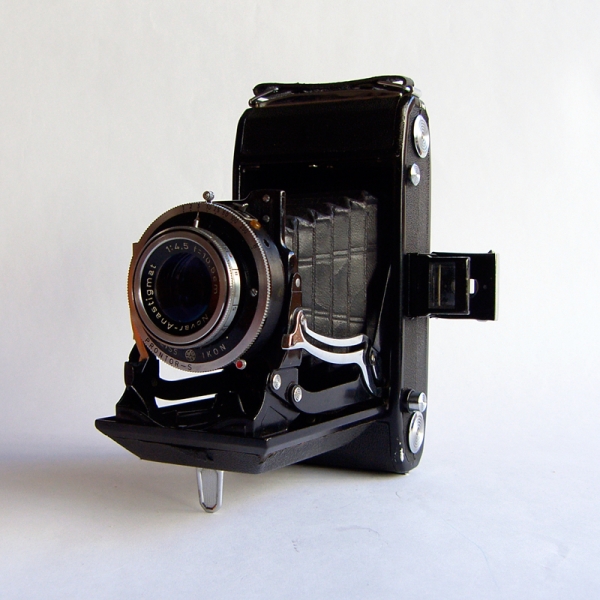
Several years ago my wife and I travelled to Prague and picked up an old fold up camera. We brought it as a kind of joke and took a few rolls of film with it. Little did we know that when we developed and printed out the photos they were absolutely stunning giving much greater detail on an 8 x 10 print then 35 mm film. Although in working condition the camera had its quirks and was very cumbersome to operate. So I picked up a second-hand Hasselblad 500 CM which was easier to operate but challenging nonetheless due to the upside down viewfinder (I haven’t given up yet). At the time the Bessa III which combines medium format negative + rangefinder composition + compact folding body seemed like the ideal solution.

Chemical Sensor
The Bessa III takes 120 roll film which can be set either to 6 x 7 or 6 x 6 frame ratio. The adjustment can be made simply by turning the clearly marked dial on the right. On my sample this dial is a bit loose and I find myself compulsively checking to make sure it is firmly set before closing the back. The two arrows across the top simply indicate where you should place the starting strip indicator on the 120 film leader. Just line the arrow up with the either the 6 x 7 or 6 x 6 indicator on the leader and you are good to go.

I prefer the 6 x 7 ratio on the Bessa III as it gives a wider field of view. This is good for street shooting because you never know what interesting things can be found on the periphery. To get some composition inspiration you can search for 6 x 7 either on google or flickr to see some good samples.
Other things of note
The two red buttons on the back do nothing more than pop the film reels off the camera. There’s a circular screw-on viewfinder protector that needs to be fastened carefully. If you manage to lose it like I did, you can pick up a Nikon branded replacement quite easily.
Hyperfocal focusing is a must learn technique for those interested in street photography. It’s not as hard as it sounds and is actually quite intuitive once you understand the concept. To get started all you have to do is to determine the range at which your subject will most likely appear. The trick is to anticipate the action before you execute the shot.
Let’s say your subject is walking towards you and you want to take a photo of them when they are at least 3 meters away. To make sure that everything is in focus from 3 meters to infinity you place the 3 meters marker on the focus dial to the center dot. Then read off the aperture setting at the infinity mark and set the aperture to that setting. Press the shutter button and as long as the subject is within this range they will be in focus.
This opens up all sorts of possibilities as you can then have the camera away from your eye or even body. No longer worried about focusing on the subject new angles and perspectives can be experimented with. And because the camera is not held up to your eye you can also take pictures very discretely. Sometimes this enables you to move right up to the subject and take the shot.

 Adventures in Photography